


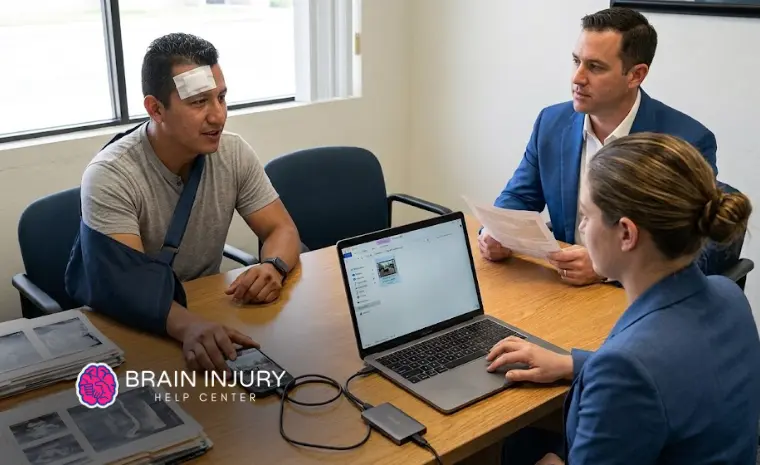
Traumatic brain injuries (TBIs) are among the most complex outcomes of a motor vehicle collision. Because brain trauma often presents as an “invisible injury” with no external wounds, insurance adjusters frequently attempt to dispute liability or claim that cognitive deficits were not caused by the crash.
To build a compelling case, securing videos after a car crash is one of the most effective steps you can take. Objective video evidence establishes the true physical impact of the collision and provides clear proof when seeking fair financial recovery.
Why Is Video Evidence Important in a Brain Injury Claim?
In any personal injury claim, the burden of proof rests on the injured party. Brain injuries often cause acute confusion, memory loss, or loss of consciousness right at the scene, making it difficult for victims to recall exact accident details.
Solid video footage eliminates reliance on conflicting verbal accounts. It provides an unbiased, minute-by-minute account of how the collision unfolded, demonstrating liability and linking the crash’s physical dynamics directly to your medical diagnosis.
What Can Dashcam Footage Reveal About a Car Accident?
Dashcams have become vital tools in modern accident investigations. Dual-facing cameras record both the roadway ahead and the vehicle interior, offering critical insights:
- Pre-Collision Behavior: Capturing traffic signals, speed, lane changes, and whether another driver was distracted.
- Cabin Audio Clues: Recording impact sounds, sudden braking, or immediate post-crash disorientation indicating head trauma.
- Impact Mechanics: Demonstrating the exact angle and force of impact, proving whether a vehicle suffered a violent rear-end or broadside collision.
Can CCTV and Surveillance Cameras Help Prove Fault?
If neither vehicle carried an active dashcam, surrounding security networks often capture the event. Commercial storefronts, gas stations, residential doorbell cameras, and municipal traffic cameras frequently record nearby roadways.
Under safety and highway monitoring frameworks established by official agencies like the Federal Highway Administration, traffic management systems monitor key intersections. While these feeds are primarily used for traffic management, their recordings can provide crucial third-party proof of liability when legally requested.
How Can Video Show the Force and Mechanics of a Collision?
A common defense strategy used by insurance adjusters is claiming that minor vehicle damage equates to a minor bodily injury. However, biomechanical studies show that rapid acceleration and deceleration forces can cause the brain to strike the inner wall of the skull even in lower-speed collisions.
Video footage allows accident reconstruction experts to calculate precise speeds and force measurements. Demonstrating these violent physical movements visually makes it much harder for insurers to deny the mechanism of a concussion or severe TBI.
Where Can You Look for Video Footage After a Car Accident?
Gathering video footage after a car crash requires a thorough search of the surrounding area immediately following the incident. Key sources to investigate include:
- Personal dashcams from all involved vehicles.
- Eyewitness smartphone videos recorded by bystanders.
- Security cameras from nearby commercial businesses or private residences.
- Public transit buses, commercial delivery trucks, or rideshare vehicles present at the scene.
- Traffic signal enforcement cameras operated by local municipalities.
How Quickly Should You Preserve Dashcam or CCTV Footage?
Time is the biggest obstacle when collecting digital evidence. Most private business security systems automatically overwrite old footage within 24 to 72 hours to conserve storage space.
To prevent crucial evidence from disappearing, a formal Spoliation Letter must be sent immediately to property owners, municipal entities, or opposing parties, ordering them to preserve all relevant video files. Partnering with a qualified California injury lawyer near me ensures that legal spoliation notices and court subpoenas are served before auto-deletion cycles permanently wipe the footage.
What If No Video of the Car Accident Is Available?
If no direct video recordings exist, a strong TBI claim can still be established using alternative technical and medical evidence.
Investigators can extract digital collision data from a vehicle’s Event Data Recorder (EDR), commonly known as the “black box.” This device logs speed, braking, and steering input seconds before impact. When combined with physical skid marks, road debris analysis, and detailed neurological assessments, expert witnesses can accurately reconstruct the crash.
Understanding the long-term work disruptions caused by cognitive impairments is equally essential; learn more about managing long-term recovery in our breakdown of how future medical expenses are calculated in a brain injury claim in California.