


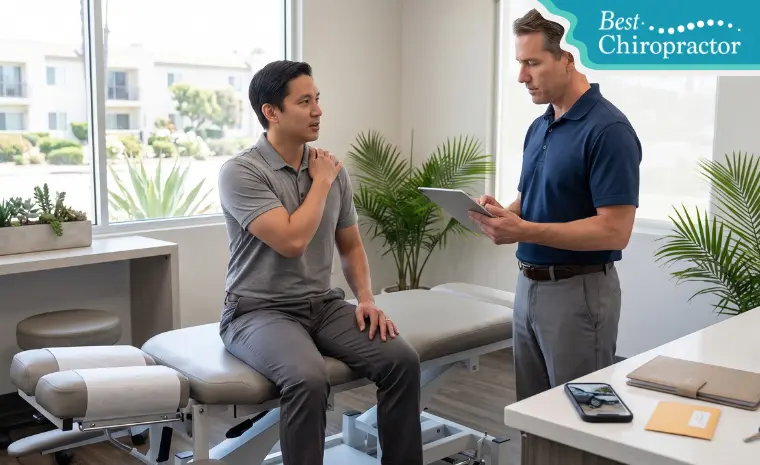
A car accident can leave you feeling sore, stiff, or simply “off,” even when there are no visible injuries. You may notice neck pain while driving down Interstate 5 in San Diego, lower-back stiffness after sitting at work, or headaches that did not appear until the day after the crash.
These injuries are common enough to result in millions of hospital visits. According to the CDC’s National Center for Health Statistics, motor vehicle crashes resulted in an average of approximately 3.8 million emergency department visits per year in the United States during 2019–2020.
A chiropractor exam after an accident can help evaluate how a collision may have affected your muscles, joints, posture, nerves, and movement. Rather than focusing only on the area that hurts most, the chiropractor can assess how different parts of your musculoskeletal system are functioning together.
The exam also provides a baseline for measuring your progress. Based on the findings, your chiropractor can determine whether conservative care may be appropriate, whether diagnostic imaging is warranted, or whether your symptoms require referral to another healthcare professional.
Medical History and Accident Details Review
The first part of the evaluation usually begins with questions.
Your chiropractor may ask about:
- Where and when the accident happened
- Whether your vehicle was struck from the front, side, or rear
- Whether you were wearing a seat belt
- Whether airbags deployed
- Your position inside the vehicle
- When your symptoms began
- Whether symptoms have changed since the crash
- Previous injuries or surgeries
- Current medications
- Existing health conditions
These details help the chiropractor understand the forces involved in the collision.
For example, a rear-end accident may place significant stress on the neck and upper back. A side-impact collision may affect the shoulders, hips, or spine differently.
Be specific about what you are feeling. Tell the chiropractor if pain travels into an arm or leg, if you feel numbness or tingling, or if ordinary activities such as sleeping, walking, or turning your head have become difficult.
This history provides important context for the rest of the exam.
Physical and Orthopedic Examination
Next, the chiropractor may perform a physical and orthopedic examination.
The goal is to determine which movements, muscles, joints, or structures may be contributing to your symptoms.
Testing may include:
- Palpation of muscles and joints
- Muscle-strength testing
- Orthopedic stress tests
- Evaluation of tenderness or swelling
- Examination of the neck, back, shoulders, hips, or extremities
- Tests designed to reproduce specific symptoms
The chiropractor may gently press or move certain areas to identify muscle spasms, joint restriction, tenderness, or instability.
Orthopedic tests can also help narrow down whether pain may be related to a joint, muscle, ligament, disc, or another structure.
A thorough chiropractic exam after an accident should not involve simply locating the painful area and immediately performing an adjustment. The initial evaluation helps determine whether chiropractic treatment is appropriate and whether additional testing is necessary first.
Neurological and Reflex Testing
Accidents can sometimes irritate or compress nerves, especially when the neck or lower back is involved. Neurological testing helps evaluate how well your nervous system is functioning. Your chiropractor may check:
- Reflexes
- Muscle strength
- Sensation
- Coordination
- Balance
- Numbness or tingling
- Symptoms that travel down the arms or legs
A reflex hammer may be used to test responses at the knees, ankles, elbows, or other areas.
The chiropractor may also compare sensation on both sides of your body or ask you to resist gentle pressure with your arms or legs.
Changes in reflexes, sensation, or strength may signal that further evaluation is needed.
If symptoms suggest a more serious neurological issue, a responsible chiropractor should refer you to the appropriate medical provider rather than continuing treatment without additional assessment.
Range of Motion, Posture, and Joint Assessment
Movement often changes after a collision. You may unconsciously protect a painful area by tilting your head, shifting your weight, or walking differently. Over time, these compensations can create discomfort in other parts of the body.
During the exam, your chiropractor may evaluate:
- Neck rotation
- Forward and backward bending
- Side bending
- Shoulder movement
- Hip mobility
- Spinal movement
- Posture
- Joint restriction
- Gait and balance
You may be asked to turn your head, bend forward, raise your arms, or perform other simple movements. The chiropractor will note whether movement causes pain, stiffness, weakness, or limited mobility.
Postural assessment may also reveal muscle guarding or compensation patterns that developed after the crash. These findings help explain not only where you hurt, but also how the injury is affecting normal movement.
X-Rays or Other Imaging When Needed
Not every chiropractic patient needs an X-ray or advanced imaging study.
Imaging should be based on symptoms, examination findings, medical history, and clinical judgment. A chiropractor may recommend X-rays when there is concern about:
- Fracture
- Significant trauma
- Structural abnormalities
- Joint degeneration
- Previous spinal injuries
- Unexplained or severe pain
More advanced imaging, such as an MRI or CT scan, may be appropriate when symptoms suggest disc injury, nerve compression, or another condition that cannot be fully evaluated through a physical exam alone.
In those situations, the chiropractor may coordinate with or refer you to another healthcare provider.
Imaging is one part of the evaluation—not a replacement for the physical and neurological exam.
How the Exam Findings Shape Your Treatment Plan
Once the evaluation is complete, the chiropractor reviews the findings and explains what they may mean for your recovery. A treatment plan may include:
- Chiropractic adjustments
- Gentle mobilization
- Soft-tissue therapy
- Stretching
- Therapeutic exercise
- Posture recommendations
- Activity modifications
- Home exercises
- Follow-up examinations
The frequency and type of care should depend on your specific condition rather than a one-size-fits-all schedule.
For example, someone with mild stiffness may need a different approach from someone experiencing significant mobility loss or nerve-related symptoms.
Your provider may also track pain levels, range of motion, strength, and functional improvements over time.
If you are searching for the best chiropractor in San Diego, look for a provider who performs a complete evaluation before recommending treatment, explains findings clearly, and refers patients to other medical professionals when symptoms fall outside the scope of chiropractic care.
A properly documented chiropractic exam after an accident can help guide conservative treatment and provide a clear record of how your condition changes during recovery.